About
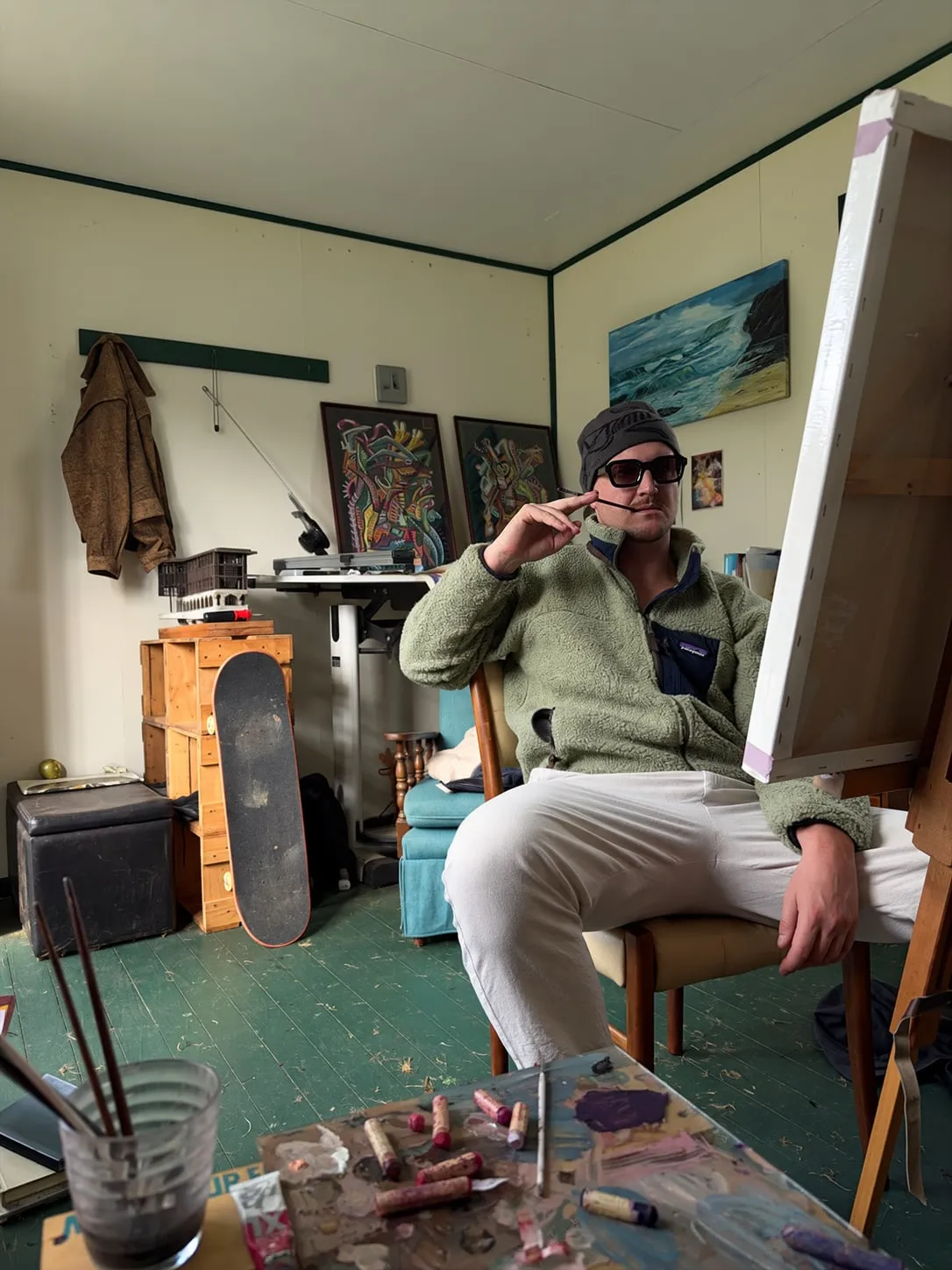
Karl Hoffmann makes work where chaos and order, art and architecture, collide.
Karl Hoffmann (b. 1995, Auckland, New Zealand) builds images out of the collision between chaos and order. He trained in architecture, not fine art, and the spark came during his research and studies for his architectural master’s. Making the drawing experiments, projections and dreamscape realms for his thesis “The Task of the Translator”, he found himself starting from loose, instinctive marks and drawing structure out of them, layer by layer. Discovery, collage, tracing, translating, trans-figuration. The process was an exact embodiment of a theory that didn’t yet have a name. It became the philosophy that now drives everything he makes: Rational Chaoticism.
Rational Chaoticism
Rational Chaoticism starts from one conviction: the most meaningful work happens where control meets surrender. Order without disorder goes stale; disorder without order is only noise. Karl treats the two as partners rather than opposites, and his paintings, drawings and architectural studies are the record of that negotiation.
The philosophy reaches well beyond the studio. It draws on the constant exchange between the unconscious, preconscious and conscious mind, on the idea that coincidence is rarely meaningless, and on the belief that an artist has to keep changing to stay alive. Karl sees it as part of a wider shift he calls Reconstructivism. Where postmodernism took meaning apart and left little in its place, his work sets out to build it again, with order and disorder as its raw materials.
The process
Every work begins with an act, not an idea. A scribble, a splash of colour, a fragment of collage: a chaotic, instinctive gesture made before the mind can edit it. From there Karl gives it structure one decision at a time, layer upon layer, until a composition emerges from the noise.
The works are rarely finished quickly. He lets them rest, comes back with fresh eyes, and lets time become a silent collaborator, so that each piece carries the weight of the hours spent inside it. His Auckland studio holds traditional tools beside unconventional materials: oil paint and oil pastel, pen, pencil and pastel, on paper and canvas, at every scale from intimate studies to The Adoration of Lilith, two metres wide.
Myth and the human condition
Myth and symbolism run through the work, always in the service of emotion and the human condition. Teeming compositions of open mouths, watching eyes, tongues, masks and chequered floors become stages where the oldest stories play out again: temptation and the fall, adoration and dread, the faces we wear and the selves we keep hidden. In The Adoration of Lilith, mythological imagery meets abstract form in a narrative that feels both timeless and personal.
Between art and architecture
The architectural drawings where it all began still run alongside the paintings. In their dense, speculative structures, lines of construction tangle into imagined cities, and rigorous geometry is pushed until it turns wild. Here Rational Chaoticism takes physical form.
A conversation across time
Karl doesn’t believe in the lone genius. His work is openly in dialogue with the artists who shaped him: the nightmarish invention of Bosch, the dreamlike distortions of Dalí, the raw energy of Basquiat, the unflinching honesty of Goya, the psychological portraits of George Condo and the restless movement of Rubens. He absorbs rather than copies, adding his own voice to a conversation that began long before him and will continue long after.
The result is work that rewards a second look, and a third. It pulls the viewer in, reveals something new the longer it’s studied, and never gives everything away at once. For Karl that’s the point: a work of art should do more than decorate a wall. It should change the person standing in front of it.